
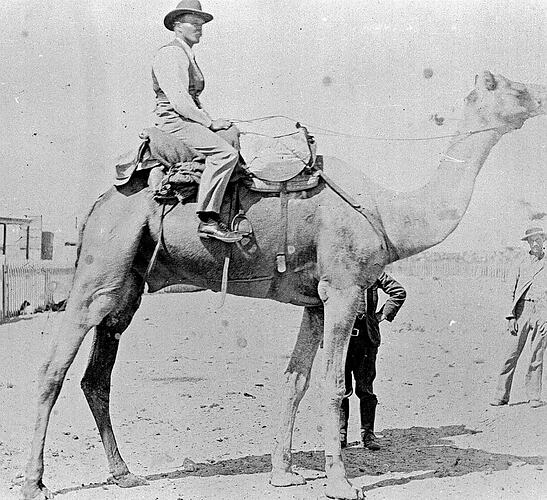
In the vast and harsh landscapes of 19th-century Australia, a unique group of pioneers emerged, shaping the nation’s history in ways that would resonate for generations to come. These pioneers were the Afghan camel drivers, commonly known as “Ghans,” who arrived in the mid-1800s with their camel trains, forever altering the Australian outback and its exploration.
The arrival of the Ghans was not merely a matter of chance but a strategic response to the challenges of the Australian interior. During this period, the exploration and development of the outback were hindered by its harsh terrain and vast distances. Traditional means of transportation, such as horses and bullocks, struggled to traverse the arid landscapes effectively. Recognizing the need for a more suitable mode of transport, enterprising individuals turned to camels, which had proven their resilience in similar environments elsewhere in the world.
The Ghans, predominantly from Afghanistan and neighboring regions, brought with them not only the expertise in handling and caring for camels but also a deep understanding of desert environments. Their arrival marked the beginning of a new era in Australian exploration, as camel trains became the primary means of transportation for goods and people across the vast stretches of the outback.
The significance of the Ghans in Australian history cannot be overstated. They played a crucial role in opening up the interior, facilitating trade, communication, and the establishment of remote settlements. Without their expertise and perseverance, many areas of the outback would have remained virtually inaccessible, hindering the expansion and development of the nation.
One of the most notable contributions of the Ghans was their involvement in the construction of the Overland Telegraph Line in the late 19th century. Stretching over 3,200 kilometers (2,000 miles) from Adelaide to Darwin, this ambitious project aimed to connect Australia with the rest of the world through telegraphic communication. The Ghans’ camel trains were instrumental in transporting supplies and equipment to remote construction sites, overcoming logistical challenges that would have otherwise been insurmountable.
Furthermore, the Ghans played a vital role in the exploration of central Australia, accompanying expeditions led by notable figures such as John McDouall Stuart and Ernest Giles. Their intimate knowledge of desert routes and water sources proved invaluable in navigating the unforgiving terrain, enabling these explorers to push the boundaries of Australian geography.

Beyond their practical contributions, the Ghans also left a lasting cultural legacy in Australia. Their presence introduced elements of Afghan culture to the outback, including cuisine, music, and architectural styles. Many place names in remote regions of Australia bear testament to their influence, reflecting the cultural diversity that characterizes the nation.
Despite their significant contributions, the story of the Ghans is often overlooked in mainstream narratives of Australian history. However, efforts are underway to recognize and commemorate their legacy, with initiatives such as the Afghan Cameleers Heritage Project seeking to preserve their history and heritage for future generations.
In conclusion, the arrival of Afghan camel drivers in the mid-19th century marked a pivotal moment in Australian history. Through their expertise, resilience, and perseverance, the Ghans played a crucial role in opening up the outback, facilitating exploration, trade, and communication. Their legacy lives on in the cultural fabric of Australia, serving as a reminder of the diverse and interconnected nature of the nation’s history.
 History Class Australia